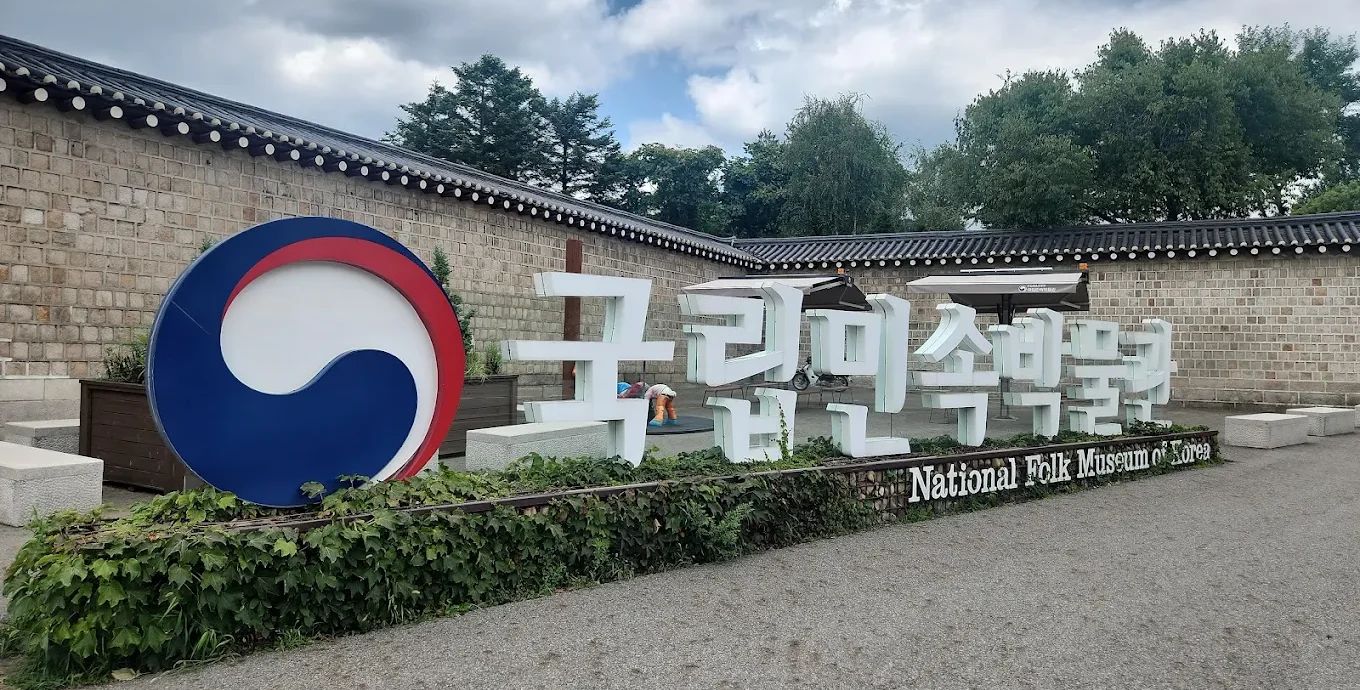
Set just inside the grounds of Gyeongbokgung Palace, the National Folk Museum of Korea (국립민속박물관) is one of Seoul's most underrated museums — and entirely free to visit. Three permanent halls and an open-air outdoor village trace Korean daily life, agricultural cycles, and family customs from prehistory through the modern era. If a Korean palace tells you about kings, the National Folk Museum tells you about everyone else.
This is the complete 2026 guide.
Quick Facts
- What: Korea's national museum of everyday life and folk culture
- Where: Inside Gyeongbokgung Palace grounds, Jongno-gu, Seoul
- Open: 9:00 AM – 6:00 PM (until 7 PM May–Aug, until 5 PM Nov–Feb)
- Closed: Tuesdays
- Admission: Free
- Best for: Families, culture lovers, rainy days, palace pairing
- Time to spend: 1.5–2.5 hours
- Nearest Station: Gyeongbokgung Station (Line 3), Exit 5
What the Museum Is
Founded in 1946, the National Folk Museum is one of Korea's three national museums (the others being the National Museum of Korea in Yongsan and the National Museum of Modern and Contemporary Art). While the National Museum focuses on royal and elite art, the Folk Museum focuses on ordinary Korean life — homes, farming, fishing, weddings, funerals, holidays, clothing, food, and traditional crafts.
The building itself is striking: a modern reinterpretation of three Korean architectural masterpieces, including the wooden tower of Beopjusa Temple and the stone foundation of Gyeongbokgung Palace.
Why It's Worth Visiting
- It's free. No ticket needed, even with the palace.
- It's compact. You can see the highlights in 90 minutes.
- It contextualizes everything else. After seeing this museum, palaces, hanok villages, and traditional foods make 10x more sense.
- It's family-friendly. A dedicated children's museum and outdoor village.
- It's air-conditioned and indoors. Perfect on hot, cold, or rainy days.
- It pairs perfectly with Gyeongbokgung. You're already on the palace grounds.
Permanent Exhibitions
Hall 1 — The Korean Way of Life
Traces Korean daily life from prehistory to the early 20th century:
- Prehistoric tool sets and pottery
- Three Kingdoms-era homes and clothing
- Joseon Dynasty (1392–1910) family life
- Traditional Korean clothing (hanbok)
- Traditional architecture
- Foodways and kitchen tools
Don't miss: the full-scale reconstructed Joseon-era kitchen (with a working ondol heating system display).
Hall 2 — The Korean Way of Working
Focuses on Korea's agricultural and seasonal cycles:
- Spring planting tools
- Summer fishing equipment
- Autumn harvest celebrations
- Winter food preservation (kimchi-making demonstration)
The annual cycle is presented as a literal walking timeline — beautifully designed.
Hall 3 — The Korean Way of Life Cycle
The human life cycle from birth to death:
- 100-day baby celebration (baekil)
- First birthday (doljanchi) and the famous "doljabi" object-grabbing ritual
- Coming-of-age ceremonies
- Traditional Korean weddings
- 60th-birthday celebrations (hwangap)
- Funeral rites and ancestor worship
The wedding diorama is one of the most photographed exhibits.
Outdoor Village
Behind the museum, a free outdoor exhibition space contains:
- A reconstructed 1960s–70s Korean village with old shops, a barber, a tailor
- Traditional houses (hanok) from various regions
- A children's playground
- Photo-worthy old phone booths and signage
The 1970s village is a Korean nostalgia time capsule — locals love it.
Children's Museum (어린이박물관)
A separate building inside the same complex:
- Hands-on Korean folk activities
- Costume-trying stations
- Folk-game playgrounds
- Story-time corners
Free entry. Reservations sometimes required during school holidays.
Special Exhibitions
The museum runs 2–3 rotating special exhibitions per year on themes like Korean tea culture, regional crafts, or shamanism. These are also free and often the most interesting reason for return visits. Check the museum website before going.
How to Get There
By Subway (recommended)
- Gyeongbokgung Station (Line 3), Exit 5 — Walk straight north to the palace gate, enter Gyeongbokgung grounds, the Folk Museum is on the right side.
- Walking time from station: 8–10 minutes.
By Bus
- Many buses stop at "Gyeongbokgung" — Bus 109, 171, 272, etc.
By Foot
- From Gwanghwamun Square: 10 minutes
- From Insadong: 15 minutes
- From Bukchon Hanok Village: 10 minutes
Note on Entrance
You can enter the museum without paying for the palace — there's a separate folk museum entrance from inside the palace grounds. If you want to combine, buy the palace ticket (₩3,000) and visit both back-to-back.
When to Visit
By Time of Day
- Morning (9–10 AM): Calmest. Ideal for the children's museum.
- Mid-day: Tour-bus crowds peak.
- Afternoon (3–5 PM): Quietest period after school groups leave.
By Season
- Spring (April): Cherry blossoms in palace grounds — beautiful pairing.
- Autumn (October): Foliage on the palace ginkgos.
- Winter: Indoor warmth + Lunar New Year demonstrations in late January.
- Lunar holidays: Free traditional games, hanbok try-on, food demos.
Closed Days
- Every Tuesday (except Tuesdays that are public holidays).
- Lunar New Year and Chuseok mornings.
What to Do With Kids
- Start at the Children's Museum (90 minutes).
- Walk the outdoor village for photo ops.
- Visit Hall 3 (life cycle) — the wedding diorama and dol birthday display.
- Pair with a snack at the Cafe Misso inside the palace grounds.
Tips From Repeat Visitors
- Bring a light layer. The galleries are well air-conditioned.
- Audio guides are free. Pick one up at the front desk (English available).
- Photography is allowed without flash.
- Explanation panels are bilingual (Korean + English) — most foreigners can follow easily.
- The outdoor village is free even when the indoor museum is closed.
- Restrooms are inside both Hall 1 lobby and the Children's Museum.
- The museum gift shop has unique folk-craft souvenirs cheaper than Insadong.
- Pair with Gyeongbokgung Changing of the Guard at 10 AM or 2 PM.
What to Combine With the Folk Museum
A perfect Jongno cultural day:
- 9:30 AM: Gyeongbokgung Palace + Changing of the Guard (10 AM)
- 11:00 AM: National Folk Museum
- 12:30 PM: Lunch in Tongin Market
- 2:00 PM: Bukchon Hanok Village walk
- 4:00 PM: Insadong shopping and tea
- 5:30 PM: Cheonggyecheon Stream walk
Accessibility
- Step-free entry to all halls via ramps and elevators.
- Wheelchair rentals available at the front desk (free).
- Stroller-friendly throughout.
- Audio guides include audio descriptions for visitors with low vision.
- Quiet rooms available for sensory breaks.
Frequently Asked Questions
Is the National Folk Museum free? Yes — admission is free for all permanent and special exhibitions.
Do I need to buy a Gyeongbokgung Palace ticket too? No. You can enter the museum without paying for the palace.
How long should I plan to visit? 1.5–2.5 hours for the main museum + outdoor village.
Is there an English audio guide? Yes — available free at the front desk. Korean, English, Japanese, Chinese.
Is it kid-friendly? Yes — the dedicated Children's Museum is one of Seoul's best.
Are pets allowed? Service animals only.
Can I bring food and drinks? Bottled water OK; food only in designated outdoor areas.
Is photography allowed? Yes, no flash. Some special exhibits may restrict.
Where is the closest restaurant? Tongin Market (5 min walk) for traditional Korean lunch; Cafe Misso inside palace grounds for coffee.
Suggested 2-Hour Visit Plan
10:00 AM — Enter via Gyeongbokgung. Pick up audio guide. 10:15 AM — Hall 1 (Korean Way of Life) — 30 min. 10:45 AM — Hall 2 (Working / Seasons) — 25 min. 11:10 AM — Hall 3 (Life Cycle) — 30 min. 11:40 AM — Outdoor village (1970s neighborhood + hanok houses) — 20 min. 12:00 PM — Children's Museum if traveling with kids. 12:30 PM — Lunch nearby in Tongin Market.
Final Thoughts
The National Folk Museum is the missing context layer for any Korea visit. Palaces show you what the kings did. This museum shows you what 99% of Koreans actually lived: harvests, weddings, funerals, kimchi-making, the warmth of the ondol-heated floor, the lullabies, the games. After 90 minutes here, you'll see the rest of Korea — including hanok cafes, traditional restaurants, and palace exhibits — with twice the depth.
Free, central, indoor, family-friendly. There is no excuse not to come.