

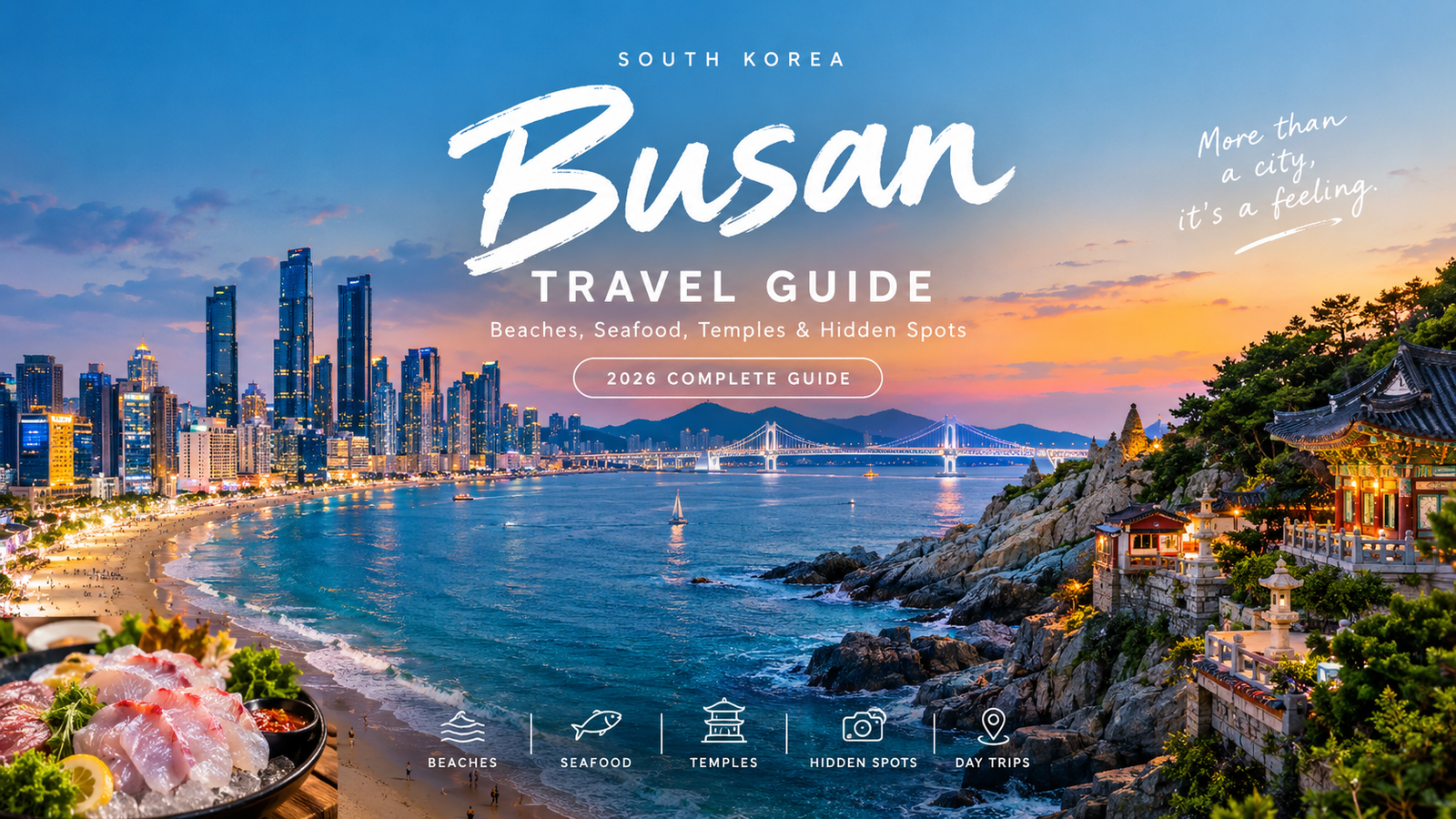
If Seoul is Korea's brain, Busan is its heart. Korea's second-largest city is wedged between forested mountains and the East Sea, with golden-sand beaches, the country's best raw fish, neon-lit night markets, and a relaxed coastal accent that turns even the most hurried Seoulite into a slow stroller within a day.Busan welcomed over 3 million international visitors in 2025 — a 23% jump on the year before — and it's not slowing down. Direct KTX trains from Seoul put it just 2 hours 15 minutes away, which means it's slipped from "second trip" status into the must-do leg of any first-time Korea itinerary.This is the complete Busan travel guide: best beaches, mountain temples, seafood markets, neighborhoods, day trips, and the practical info you need to make a 2- or 3-day visit really sing.
Why Visit Busan
Busan punches above its weight on every front:
- Six city beaches. Haeundae and Gwangalli are world-class, with bridges that light up at night.
- Mountain temples by the sea. Haedong Yonggungsa is one of the few in Korea built right on the coast.
- Korea’s best raw fish (hoe). Locals eat it standing at Jagalchi Market with soju and chili paste.
- Murals, sky capsules, suspension bridges, and a 4 km coastal sky walk.
- A tighter, more walkable feel than Seoul — most highlights cluster along three subway lines.
Two to three days is the sweet spot for a first visit. Four days lets you slow down and hit Tongyeong or Gyeongju as a side trip.
When to Visit Busan
- April–June: The classic sweet spot. Cherry blossoms early April, jacarandas and roses by May, beach weather from June.
- September–October: Warm seas, blue skies, fewer crowds. Many travelers’ favorite window.
- July–August: Peak beach season — vibrant but Haeundae is shoulder-to-shoulder.
• ⁃ November–March: Cool, dry, quiet. Mountain temples and food markets shine; the beach is for walking only.
Here you can explore what best things to do in Busan, Jeju Island and must visit places in Seoul
How to Get to Busan
From Seoul: KTX from Seoul Station to Busan Station, 2 hours 15 minutes (₩59,800 reserved seat). The SRT from Suseo also runs about the same time.
From overseas: Gimhae International Airport (PUS) connects to most of East and Southeast Asia. From the airport to downtown is 30–40 minutes by airport bus or subway.
Inside Busan: The metro is excellent (Lines 1, 2, 3, 4) and a single T-money card works between Seoul and Busan transit. Taxis are noticeably cheaper than in Seoul.
Best Beaches in Busan
Haeundae Beach (해운대)
The headliner. A 1.5 km golden-sand crescent backed by skyscraper hotels and seafood restaurants. Crowded in summer, peaceful in shoulder season. Sunrise here is one of the most underrated experiences in Korea.
Anchor your beachside afternoon with a coffee at one of the Haeundae Mipo cafés at the eastern end, then walk to The Bay 101 for sunset cocktails over the marina.
Gwangalli Beach (광안리)
Locals’ favorite. Slightly smaller than Haeundae but with a better café strip and the iconic Gwangan Bridge lighting up across the water at night. The bridge hosts Korea’s most famous fireworks festival each autumn.
Songjeong Beach (송정)
Quieter, surfable, popular with younger travelers and surf schools.
Songdo Beach (송도)
Closer to downtown, with the Songdo Cloud Trails elevated coastal walkway and the Songdo Marine Cable Car running across the bay.
Dadaepo Beach
Far west, broad and sandy, with a sunset musical fountain show in summer evenings.
Mountain Temples & Coastal Walks
Haedong Yonggungsa Temple (해동용궁사)
One of the few Korean temples built right on a cliff over the sea. Walk through the dragon-arched stone tunnel, then descend the 108 steps to a stunning ocean panorama. Best at sunrise.
Beomeosa Temple (범어사)
Tucked into Geumjeongsan Mountain, founded in 678 AD. Take the cable car partway up, then hike through pine forest to the temple. Combine with the Geumjeongsan fortress walls.
Igidae & Oryukdo Coastal Walk
A dramatic 4 km cliff trail east of Gwangalli, with Oryukdo Skywalk — a glass-bottomed cantilever — at the end.
Songdo Cloud Trails & Coastal Bollegil
A 3 km elevated walkway over the Songdo cliffs. Free, family-friendly, and one of the most photographed coastal trails in Korea.
Iconic Busan Spots
Gamcheon Culture Village (감천문화마을)
Built in the 1950s as a refugee settlement on the side of a mountain, Gamcheon has been transformed since 2009 into Korea’s most colorful village — pastel houses stacked like Lego, narrow alleys, mural art, indie cafés, and panoramic viewpoints. Allow 2 hours.
Huinnyeoul Culture Village
Quieter, Mediterranean-feeling cliffside village on Yeongdo Island. Cafés perched directly over the water, and stunning sunset views.
Busan X The Sky
Korea’s second-tallest observation deck on the 100th floor of Haeundae LCT. Glass-floor section, the country’s highest Starbucks, and uninterrupted views over the Diamond Bridge.
Haeundae Blueline Park
Old train tracks repurposed into Korea’s coolest coastal ride. Choose between the Sky Capsule (private 4-person glass cabin) and the Beach Train (open-window panorama).
Tip: Sky Capsules sell out — book online at least a day in advance.
Skyline Luge Busan
A 1.7 km gravity-powered cart ride down the hills above Gijang. Six laps recommended. Family-friendly.
Seafood Markets & Food Streets
Jagalchi Market (자갈치시장)Korea's largest seafood market. Choose your live octopus, abalone, or hoe (raw fish) at a tank, and the second floor restaurants will prepare it for you. The standing-bar outdoor stalls at the back are where locals eat — rougher, cheaper, and more memorable.Gukje Market & BIFF SquareSprawling traditional market with everything from imported snacks to old movie posters. The BIFF Square food street nearby is famous for ssiat hotteok — sweet pancakes stuffed with seeds, brown sugar, and cinnamon — found nowhere else in Korea.Gijang MarketSpecializes in king crab and snow crab — peak season November through April.Haeundae MarketA small but excellent traditional market two blocks from the beach, with great snack options and a cheaper alternative to the beachfront restaurants.What to Eat in BusanDwaeji gukbap (돼지국밥) — Pork bone soup with rice. Busan's soul food. The best is at Songjeong-3-dong or near Seomyeon.Ssiat hotteok — Seed-stuffed sweet pancakes, BIFF Square exclusive.Eomuk (어묵) — Busan-style fish cake. Korean fish cake originated here and Samjin Eomuk in Yeongdo is the most famous brand.Hoe (회) — Korean-style sashimi, eaten with chili-garlic sauce. Best at Jagalchi or Cheongsapo.Milmyeon (밀면) — Wheat noodles in cold broth. The Busan answer to naengmyeon.King crab — In Gijang Market, in season November–April.• ⁃ Coffee at Cheongsapo — Busan has somehow become Korea's specialty-coffee capital. The cafés around Cheongsapo and Gwangalli rival anything in Seoul.
A Suggested 3-Day Busan Itinerary
Day 1 — Beaches & The Sky9 AM: Haeundae Beach + breakfast café walk10:30 AM: Busan X The Sky observatory12:30 PM: Haeundae Mipo lunch2:00 PM: Haeundae Blueline Park (Sky Capsule)4:30 PM: The Bay 101 marina, sunset cocktails7:00 PM: Gwangalli Beach dinner with Diamond Bridge viewsDay 2 — Temples, Hills, Markets8 AM: Haedong Yonggungsa Temple sunrise11 AM: Skyline Luge Busan1 PM: Lunch at Gijang Market3 PM: Gamcheon Culture Village6 PM: Jagalchi Market hoe dinner9 PM: BIFF Square ssiat hotteok dessertDay 3 — Coastal Walks & Slower Busan9 AM: Igidae–Oryukdo coastal walk + Oryukdo Skywalk12 PM: Lunch in Gwangalli2 PM: Songdo Cloud Trails + cable car4 PM: Huinnyeoul Culture Village6 PM: Yongdusan Park & Busan Tower• ⁃ 7:30 PM: Final dinner — dwaeji gukbap somewhere local
Where to Stay in Busan
Haeundae: Best for beach lovers. Stay at the Park Hyatt, Signiel Busan, or any of the mid-range options behind the beach.Gwangalli: Best for night views. Boutique hotels and serviced apartments along Gwangalli Beach.Seomyeon: Best for budget travelers and food. The transit hub of Busan with cheap dwaeji gukbap and lively nightlife.Nampo-dong / Jagalchi: Best for food-first trips and proximity to Gukje Market and BIFF Square.
Practical Busan Tips
Subway pass: A T-money card works the same in Busan as in Seoul. Top up at any convenience store.Tipping: None.Language: Less English than Seoul, especially in markets. Naver Map and Papago translate menus easily.Cash vs card: Almost everything takes card. Markets prefer cash.Combine with Gyeongju: A KTX day trip to Gyeongju (the ancient Silla capital) takes only 30 minutes — easy to add to a 3-day Busan plan.Festivals: Busan International Fireworks Festival (October), Busan International Film Festival (October), Haeundae Sand Festival (May).
Day Trips From Busan
Gyeongju — 30 minutes by KTX. UNESCO temples, royal tombs, lotus ponds.Tongyeong — 1.5 hours by bus. The "Naples of Korea" — fishing harbors, oyster villages, and the Hallyeo Marine Cable Car.• ⁃ Geoje Island — 2 hours. White cliffs, fishing villages, peaceful beaches.
Frequently Asked Questions
Yes for highlights. 3 days is the sweet spot.What's the best beach in Busan? Gwangalli for atmosphere and night views; Haeundae for size and convenience.Is Busan safe at night? Extremely. Korean cities are among the safest in the world. Walking Gwangalli or Haeundae at night is fine.Should I do Seoul or Busan first? Seoul first if flying into ICN, then KTX south. Many travelers prefer this rhythm — energetic capital, then slower coastal city.Do people speak English in Busan? Tourist staff in major hotels do. In markets and outside the tourist zones, less so. Translation apps work fine.
Takeways
Busan is the city that surprises every Korea traveler. It has Seoul's modernity but a slower pulse, mountain temples that drop straight into the sea, raw fish so fresh it twitches, and a beach culture that lives well beyond the summer months. Two days will give you the highlights; three will let you fall in love. Either way, do not skip it on your Korea trip.